Mar 19, 2024 / Regulation / 3 min read
Remote ID Enforcement Has Started. Here Is What Changed
On March 16 the FAA stopped exercising discretion on Remote ID. The rule has been in force for a while, but until this month operators who were not yet compliant were being nudged rather than penalised. That period is over, and non compliance is now grounds for a fine or action against a remote pilot certificate.
We wrote about the delay when it was announced last autumn. Now that the date has passed, it is worth looking at what this actually does, because it is both smaller and more consequential than the coverage suggests.
What the broadcast contains
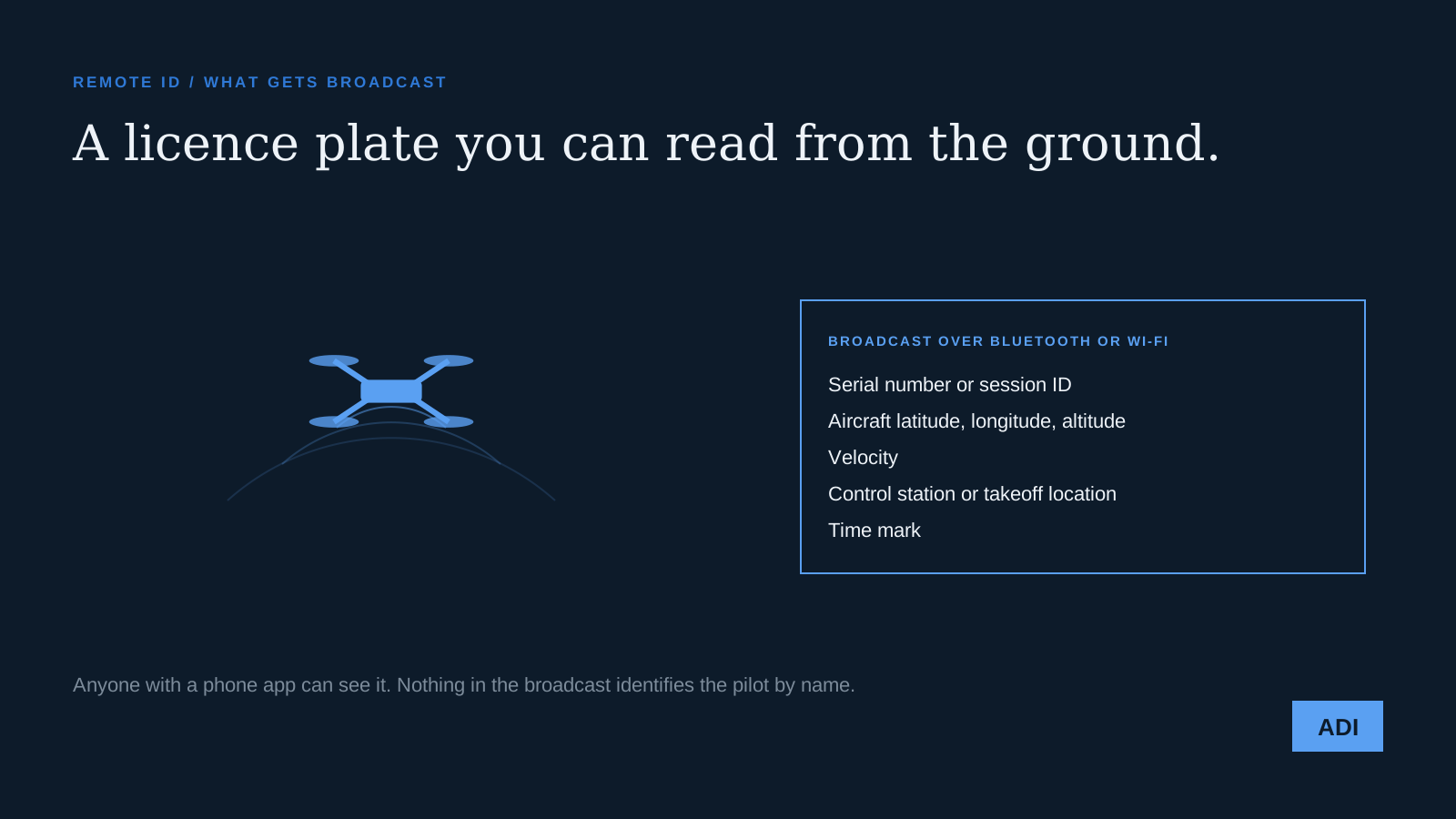
While the aircraft is airborne it transmits, over Bluetooth or Wi-Fi, a packet with the aircraft serial number or a session identifier, its latitude, longitude and altitude, its velocity, the position of the control station or the takeoff point, and a time mark. The range is line of sight, roughly what a phone can pick up nearby.
What it does not contain is the pilot's name, the operator's company, or anything about the job. A neighbour with a receiver app can see that an aircraft is up and where it launched from. Identifying the person behind it requires a serial number lookup, which is available to law enforcement rather than to the public.
Three ways to comply
Standard Remote ID aircraft broadcast natively. Most professional airframes sold in the last few years do, sometimes only after a firmware update, which is worth verifying rather than assuming. Older aircraft can carry a broadcast module, a small transmitter that attaches to the airframe and broadcasts the takeoff location instead of the control station location. The third route is to fly inside a FAA recognised identification area, which is a defined site, typically a club field, and is not a realistic option for commercial work at client locations.
What changes for a client
Operationally, nothing. The broadcast is passive, needs no connection, and adds no time to a job. What changes is the social dynamic around a flight.
Before this, a property manager who saw a drone over the parking deck had no way of telling a hired commercial crew from a stranger. Now they can see that an aircraft is broadcasting, and increasingly they know that a compliant aircraft implies a compliant operator. That is quietly useful to anyone paying for aerial work, because it shifts the default assumption from suspicion to legitimacy.
What it does not do
Remote ID does not grant airspace access, does not replace an authorization near an airport, and does not permit flights over people or beyond visual line of sight. Several operators seem to have believed that compliance was a key that unlocked other permissions. It is not. It is the identity layer underneath everything, and every future expansion of what drones may do will be built on top of it.
If you hire crews
Add one line to whatever you already ask. Is your aircraft Remote ID compliant. Any professional operator answers yes without elaborating. If the answer is a story about a module on order, the correct response is to book someone else, because that story has now been available for six months longer than it should have been.
Our fleet has broadcast natively since before the original deadline. If you have work coming up in Atlanta and you would rather not think about any of this, let us handle it.